

Essential Questions to Ask a Wedding Venue Before Booking in 2026
What if the biggest threat to your wedding budget isn't your guest count, but the fine print lurking in your rental contract? It's easy to fall in love with picturesque architecture, but touring an event space is only half the battle. Knowing the critical questions to ask a wedding venue before booking is essential to protect your peace of mind. You shouldn't have to worry about surprise overtime charges, restrictive catering lists, or confusion over what an on-site team actually handles during your reception.
You deserve full transparency before signing a legally binding agreement. In this guide, you'll discover the exact questions couples need to uncover hidden fees, clarify decor and timeline policies, and assess every room objectively. Ahead, we break down an actionable vetting checklist so you can choose your venue with complete confidence.
Table of Contents
Why Asking the Right Questions Before Booking Protects Your Wedding
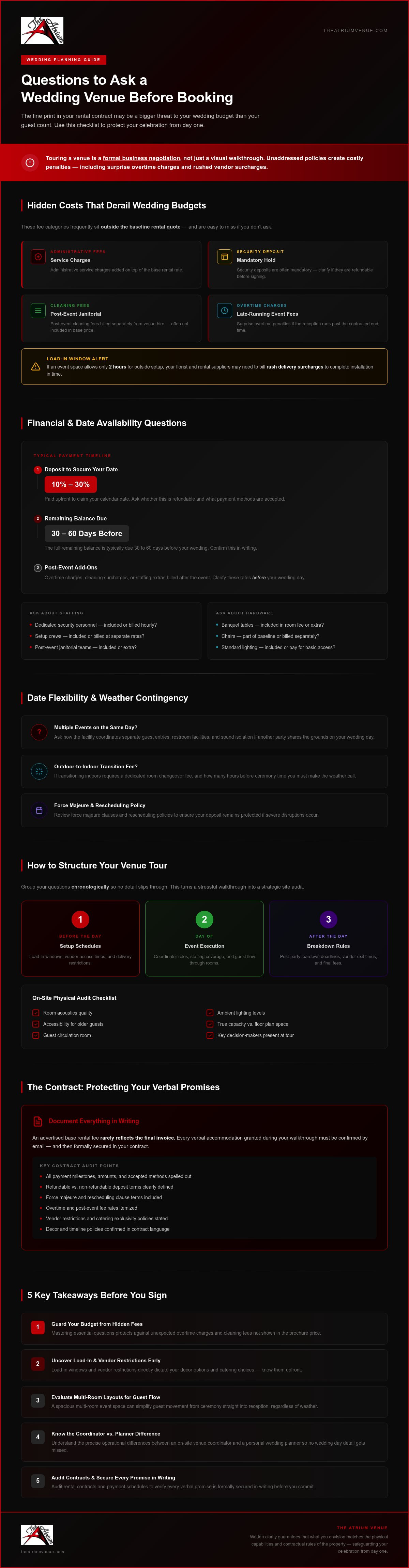
Walking through a potential venue often feels magical. You picture the vows, the dancing, and the toasts. Yet, touring a property is far more than a visual walkthrough; it's a formal business negotiation. Overlooking basic facility guidelines early on can quickly derail your planning. Unaddressed venue policies frequently create friction between outside vendors and on-site staff, triggering costly penalties like surprise overtime charges. Establishing a comprehensive list of questions to ask a wedding venue before booking allows you to evaluate dissimilar venues objectively, ensuring that every operational reality aligns with your expectations.
The True Cost of Overlooking Venue Policies
Hidden operational fees can quietly dismantle a well-planned budget. Administrative service charges, mandatory security deposits, and post-event cleaning fees frequently sit outside the baseline rental quote. Inflexible load-in windows create another major bottleneck. If an event space permits only two hours for outside setup, your florist and rental suppliers may need to bill rush delivery surcharges to complete their installations in time. Failing to verify true capacity limitations can also compromise your floor plan, crowding dining tables together and limiting room for guest circulation during the wedding reception.
How to Structure Your Questions During an Initial Tour
Approach every tour with a systematic framework so you capture every logistical constraint before signing a contract:
Group questions chronologically: Start with setup schedules, move to day-of event execution, and finish with post-party breakdown rules.
Audit the physical environment: Bring key decision-makers to evaluate room acoustics, ambient lighting, and accessibility for older guests.
Document verbal commitments: Request email confirmation for every verbal accommodation granted during your walk-through.
Bringing structured questions to ask a wedding venue before booking transforms a stressful walkthrough into a strategic site audit. Written clarity guarantees that what you envision matches the physical capabilities and contractual rules of the property, safeguarding your celebration from day one.
Financial and Date Availability Questions to Ask Upfront
Securing your ideal calendar date means very little if the financial terms underneath are clouded in ambiguity. When building your list of questions to ask a wedding venue before booking, placing financial boundaries and scheduling rules at the top of your agenda is vital for long-term peace of mind.
Total Pricing Transparency and Payment Milestones
An advertised base rental fee rarely reflects the final invoice. Your total venue investment is defined by the full operational cost to open, equip, and staff the doors, not merely the rental rate on a brochure. Request an itemized proposal early, and ask targeted questions regarding:
Payment milestones: Venues typically require a deposit between 10% and 30% to secure a date, with the remaining balance due 30 to 60 days before the wedding. Clarify refundable deposit terms and accepted payment methods.
Operational staffing charges: Inquire whether dedicated security personnel, setup crews, and post-event janitorial teams are included or billed at separate hourly rates.
Hardware inclusions: Determine whether baseline essentials like banquet tables, chairs, and standard lighting are included in the room fee, or if you must pay extra for basic access.
Reviewing a comprehensive list of questions will help you identify these line items before entering a binding financial agreement.
Date Flexibility and Weather Contingency Terms
Calendar availability involves more than claiming a Saturday. Always clarify whether the facility books multiple events on the same calendar day. If another party shares the grounds, ask how the facility coordinates separate guest entries, restroom facilities, and sound isolation so your celebration feels entirely private.
For celebrations featuring outdoor plans, evaluate backup protocols carefully. Ask if transitioning indoors requires a dedicated room changeover fee, and verify how many hours before ceremony time you must make the weather call. If you want seamless indoor flexibility, touring a spacious multi-room event space allows your ceremony, cocktail hour, and dinner reception to transition smoothly regardless of the forecast. Finally, review force majeure clauses and rescheduling policies to ensure your deposit remains protected if severe disruptions occur.
Layout, Vendor, and Decor Logistics to Clarify Early
Bringing your wedding vision to life requires seamless harmony between outside vendors and the venue itself. Understanding how your venue regulates outside talent, structural decor, and guest movement will protect you from unexpected operational headaches. Integrating logistical inquiries into your list of questions to ask a wedding venue before booking ensures your aesthetic plans never collide with rigid facility restrictions.
Vendor Freedom vs. Exclusive Vendor Lists
Some venues require you to hire exclusively from a mandatory preferred vendor list, while others grant complete flexibility. If you must use preferred caterers, your menu choices may be limited, and food costs can quickly escalate. Ask these essential vendor questions upfront:
Can we bring our own licensed caterer and bartending team, or are we locked into an exclusive catering roster?
What are the exact insurance coverage minimums required for outside vendors, such as a Certificate of Insurance listing the property as an additional insured?
Does the kitchen include commercial prep stations, warming ovens, and cold storage, or must caterers supply their own cooking equipment?
Setup Times and Decor Limitations
Transforming an empty room into an extraordinary setting takes hours of diligent labor. Confirm the precise morning load-in time allowed for florists and lighting designers. Many venues enforce strict decor bans against open flames, hanging ceiling installations, standard wall tapes, or real floral petals. Sourcing dedicated, in-house decor packages directly from your venue can eliminate third-party rental coordination completely. Selecting comprehensive decor packages ensures your centerpieces, backdrops, and table linens are fully compliant with house policies from the start.
Multi-Room Flow and Space Versatility
Guest experience hinges on how naturally attendees navigate your event. When touring a property, assess how easily people can move between key stages of the day:
Ceremony-to-reception flow: Ask whether you must endure an awkward room flip where staff rearranges tables while guests stand in a hallway, or if you can book separate spaces. A multi-room facility featuring dedicated spaces like the Platinum, Paragon, and Diamond rooms lets guests transition smoothly from the ceremony to cocktails and dinner without interruption.
Acoustic buffering: Verify that adjacent suites feature proper sound insulation so speeches aren't disrupted by neighboring celebrations.
Accessibility and comfort: Check the proximity of ADA-compliant restrooms and ask whether a private, furnished bridal suite is reserved exclusively for your party.
Covering these targeted questions to ask a wedding venue before booking will help you design a celebration that runs like clockwork.
Understanding the Venue Coordinator Role vs. Wedding Planner
One of the most frequent points of confusion for engaged couples is assuming a venue coordinator acts as a personal wedding planner. While both are critical to a smooth celebration, their operational boundaries differ completely. Clarifying these distinct responsibilities is one of the most vital questions to ask a wedding venue before booking, ensuring no logistical detail falls through the cracks.
What a Venue Coordinator Manages on Event Day
A venue coordinator is an on-site representative whose primary obligation is managing the facility's physical infrastructure, safety compliance, and property staff. They regulate HVAC climate controls, adjust architectural lighting, verify emergency exits remain clear, and liaise with catering crews regarding kitchen power connections and waste removal. Unlike an independent wedding planner, they don't cue your wedding party down the aisle, manage your personal photographer's shot list, or fluff your train before the processional.
Key Questions to Ask About On-Site Staffing
To eliminate day-of surprises, ask targeted questions about who will physically be on site during your event:
Will the representative who guided our walkthrough be our dedicated on-site contact on the wedding day?
How many facility staff members will remain on the property throughout dinner and dancing to assist with venue needs?
Who steps in to resolve unexpected facility emergencies, such as an electrical breaker overload or a restroom plumbing issue?
How In-House Decor and Logistics Teams Support the Day
Venue operations teams handle the heavy lifting that makes a reception space functional. On-site staff place venue-provided tables and chairs according to your approved schematic before outside vendors step foot on the property. Sourcing dedicated in-house decor packages simplifies this process even further. Selecting venue-managed decor packages ensures that elaborate backdrops, premium linens, and table centerpieces are set up professionally without requiring you to hire separate staging crews. If you want an organized celebration supported by experienced hospitality professionals, schedule a facility walkthrough to see how our dedicated on-site team supports your plans.
Making the Final Decision and Reviewing the Venue Contract
Once you gather estimates from your favorite spaces, the final step is moving from casual tours to analytical contract evaluation. Comparing comprehensive proposals side-by-side reveals the true cost-per-guest differentials between venues, cutting through surface impressions. The most decisive phase of asking the right questions to ask a wedding venue before booking happens during this final contract audit, where you ensure every spoken reassurance is formally written into your agreement.
Auditing the Contract Fine Print Before Signing
Never sign a rental agreement based purely on verbal assurances. Scrutinize the fine print carefully, checking for these critical contractual clauses:
Specific facility access hours: Verify the contract explicitly states your exact arrival time, music shut-off time, and teardown completion limit.
Precise room designations: When booking a multi-room facility, ensure the agreement lists each reserved space by name, such as the Platinum, Paragon, or Diamond rooms, rather than stating a generic building rental.
Aesthetic package documentation: Confirm that your selected decor packages, table dimensions, chair counts, and ambient lighting additions are itemized in writing.
Security deposit return timeline: Check the exact conditions and mandatory days required for the venue to return your post-event damage deposit.
Securing Your Date with Complete Confidence
Signing your contract and submitting your initial deposit should feel rewarding, not nerve-wracking. Before releasing funds, confirm preferred contact channels and establish baseline communication turnaround times for future planning questions. Knowing whether the venue prefers email ticketing, phone calls, or scheduled planning check-ins sets healthy boundaries for the months ahead.
Taking the time to resolve these foundational questions to ask a wedding venue before booking clears the path forward. Once your rental contract is executed with complete clarity, you can book your photographer, secure your entertainment, and finalize your invitations with total peace of mind!
Choose Your Wedding Venue with Total Peace of Mind
Finding the right setting sets the stage for your entire celebration. When you arrive prepared with the essential questions to ask a wedding venue before booking, you eliminate surprise fees, clarify vendor boundaries, and protect your investment. Touring with a discerning eye ensures that every operational detail is accounted for long before you sign on the dotted line.
Your wedding deserves a setting that pairs logistical excellence with warm, attentive hospitality! The Atrium Venue features a spacious 8,300-square-foot multi-room facility designed to accommodate varied guest lists and support an effortless ceremony-to-reception flow. With turnkey decor packages that simplify event styling and dedicated event staff focused on seamless facility execution, we handle the physical setup so you don't have to worry about a thing. Explore our versatile event spaces and curated decor packages today, and take the next step toward your celebration with complete confidence!
Frequently Asked Questions
What are the most critical questions to ask a wedding venue before booking?
The most important questions address total financial commitments, vendor policies, and day-of access hours. Always ask what is included in the base rental, whether you must use exclusive catering vendors, and when morning setup begins. Bringing a focused checklist of questions to ask a wedding venue before booking guarantees that you uncover mandatory staffing fees or restrictive timeline rules before signing a binding contract.
What is the difference between a venue coordinator and a wedding planner?
A venue coordinator manages the building's physical operations, while a wedding planner advocates directly for the couple. The venue coordinator oversees lighting controls, heating or cooling systems, safety compliance, and property staff. An independent wedding planner coordinates your personal vendor timeline, directs the ceremony rehearsal, and handles day-of personal emergencies so you can stay relaxed.
Can we bring our own outside caterer and alcohol to a wedding venue?
Policies vary widely depending on the property's operational model and commercial licensing. Many venues permit licensed, insured outside caterers but regulate bar service through in-house bartending teams or specific permit requirements. Always ask whether the venue charges a corkage fee or kitchen usage fee if you choose outside culinary providers instead of their preferred partners.
What hidden fees should couples look out for in wedding venue contracts?
Common surprise charges include administrative service fees, mandatory cleaning costs, and hourly rates for private security guards. You should also watch for room turnover fees, overtime penalties, and charges for basic audio gear or table rentals. Asking the venue for an itemized invoice early helps you review every line item before paying your deposit.
How many hours are typically included in a wedding venue rental package?
Standard rental agreements generally cover between 8 and 12 hours of total building access. This timeframe must include morning vendor deliveries, guest arrivals, your reception, and post-event cleanup. Clarify whether additional setup hours can be reserved in advance, and confirm the exact time music must shut off at night to comply with local noise ordinances.
What should we ask about wedding venue decor restrictions?
Ask about specific prohibitions regarding open taper candles, confetti, ceiling hangings, and standard wall adhesives. Many properties enforce strict rules to protect architectural finishes and fire safety systems. To avoid unexpected limitations, consider booking curated decor packages directly through your venue, which ensures all design elements comply with facility regulations.
What happens if our wedding exceeds the contracted end time?
Exceeding your reserved rental window triggers steep overtime penalties, which are typically billed in thirty-minute or one-hour increments. These charges compensate on-site facility monitors, security guards, and housekeeping crews required to stay late. Always ask about the exact hourly overtime rates and ensure your event planner schedules cleanup well before the doors close.
How far in advance should we book our wedding reception venue?
Securing popular venues for prime weekend dates usually requires booking 12 to 18 months ahead. Highly sought-after seasons fill up quickly, making early tours essential for snagging your preferred date. Starting your search early gives you ample time to bring critical questions to ask a wedding venue before booking, ensuring you find the right space without feeling rushed.


Comments