

Annual General Meeting Venue: How to Choose a Space That Works
What if the room is the difference between an orderly AGM and a meeting that feels hard to follow? Choosing an annual general meeting venue means looking beyond appearance. Attendees need to register, hear presentations, take part in voting, and join discussions without feeling rushed or crowded.
It’s understandable to want a space that feels both professional and welcoming. The right setup supports the meeting format, suits the expected attendance, and helps everyone understand where to go and how to participate.
This guide explains how to assess venue criteria, plan room arrangements and attendee flow, and account for the practical needs of formal business. You’ll also see how a flexible space can adapt to your organization’s plans. The Atrium Venue offers 8,300 square feet across the Platinum, Paragon, and Diamond rooms, with the option to rent individual rooms or the full venue. Customizable decor packages can help create a polished atmosphere for your AGM.
Table of Contents
Why the Annual General Meeting Venue Shapes the Whole Meeting
Organizing a formal meeting for shareholders, members, directors, and staff involves several moving parts. The agenda has to be clear, people need a fair opportunity to take part, and the setting should suit the decisions being discussed. Choosing an annual general meeting venue is more than finding a room with enough seats. The space can affect how easily attendees follow the proceedings and how smoothly the meeting unfolds.
An annual general meeting is a scheduled gathering where an organization reviews its affairs and gives members or shareholders a forum to hear updates and address relevant matters. The exact purpose and format vary by organization. For a broad overview of common practice, see What is an Annual General Meeting?
What makes an annual general meeting different?
An AGM often brings together people with different roles and levels of familiarity with the organization. Its agenda may include reviewing performance, discussing future plans, hearing reports, or addressing member or shareholder matters. Those formal purposes distinguish it from a routine internal meeting, which may focus mainly on day-to-day coordination among colleagues.
There isn’t one agenda or set of obligations that applies to every organization. Applicable rules and governing documents can shape what needs to be covered and how the meeting is conducted. Establish those requirements first, then plan a room arrangement that supports the scheduled presentations, discussion, and participation.
How the setting affects attendee confidence
Attendee experience starts before the meeting begins. A clear arrival point and registration area help people know where to go. Once seated, guests should be able to see the speaker and presentation materials, hear what’s being said, and remain comfortable throughout the agenda. If attendees have to search for the room, strain to follow a presentation, or navigate awkward seating, attention can shift away from the business at hand.
A considered setting helps the meeting feel prepared and professional. Seating directed toward a presentation can make reports easier to follow, while a layout that lets attendees see one another can support discussion. Clear routes between registration, seating, and meeting activities can reduce interruptions. These choices don’t guarantee participation, but they can remove practical barriers to focusing and contributing.
Atmosphere matters, too. A polished, welcoming room can help attendees feel expected and respected, while an overly casual or poorly arranged space may not match the meeting’s purpose. The venue can’t do the work of the chair or the agenda. Its role is to support clear communication and help attendees concentrate on the decisions and conversations in front of them.
A venue can support a well-run AGM, but it can’t replace sound preparation, fair meeting procedures, or the organization’s governance responsibilities. Treat the room as one part of the plan: it should make the meeting easier to attend and follow, while organizers remain responsible for its content and conduct.
How to Evaluate an Annual General Meeting Venue
A useful venue search begins with the meeting, not a wish list of amenities. Before comparing spaces, write down who is expected, what the agenda requires, and how attendees will take part. This helps you judge whether a room supports the work of the AGM, rather than simply looking appealing.
Match the room to attendance and agenda
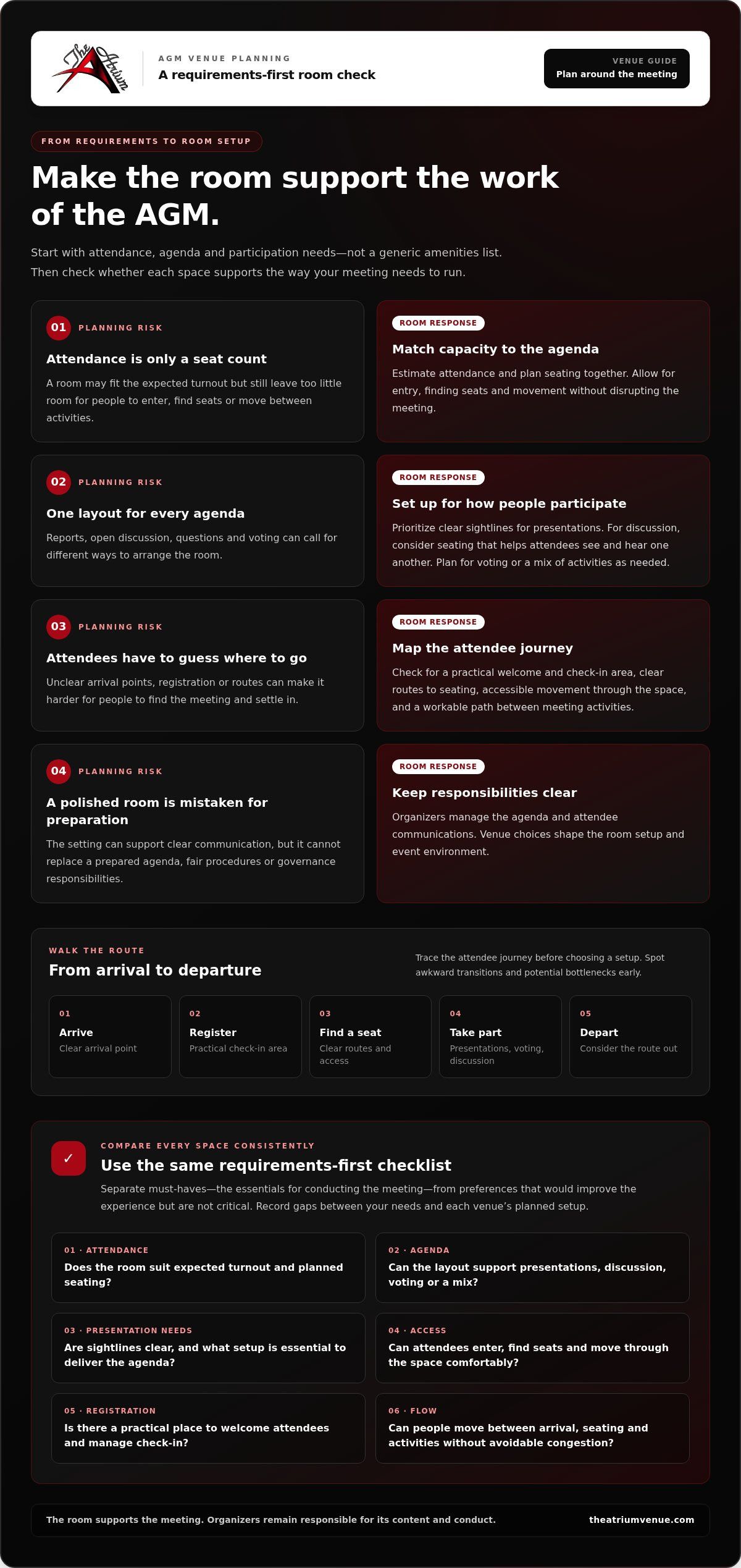
Estimate attendance, then outline the agenda. Is the meeting mainly presentation-led, with reports and updates? Will it include open discussion, questions, or voting? Each format affects the room setup. A presentation needs clear sightlines; discussion may benefit from seating that makes it easier to see and hear one another. Include enough room for people to enter, find seats, and move between activities without disrupting the meeting.
Assess attendee access and participation needs
Think through the attendee journey from arrival to departure. Where will people check in, and how will they find the meeting area? Consider accessible movement through the space, clear routes to seating, and whether attendees can see and hear the speakers. If the agenda changes activities, map how people will move between areas. List any presentation or voting needs as part of your setup plan so they’re considered alongside the room arrangement.
Use a requirements-first comparison checklist
Apply the same written checklist to every space you consider. Separate must-haves, which are essential to conducting the meeting, from preferences that would improve the experience but aren’t critical. That distinction keeps comparisons focused and makes trade-offs easier to discuss with your planning team.
Attendance: Does the room suit your expected turnout and planned seating?
Agenda: Can the layout support presentations, discussion, voting, or a mix of activities?
Presentation needs: Are sightlines clear, and what setup is essential to deliver the agenda?
Access: Can attendees enter, find their seats, and move through the space comfortably?
Registration: Is there a practical place to welcome attendees and manage check-in?
Flow: Can people move between arrival, seating, and meeting activities without avoidable congestion?
Record how each venue measures up, noting any gaps between your meeting’s requirements and the planned setup. Keep venue decisions distinct from organizer responsibilities: the room can support access and participation, while your team remains responsible for the agenda, attendee communications, and meeting procedures.
With the criteria in hand, you can compare options more confidently. The Atrium Venue offers individual room rentals as well as the full multi-room venue, giving organizations different space options to consider for an AGM. Explore The Atrium Venue’s room options as you plan a setup around your meeting requirements.
Which AGM Venue Layout Best Fits Your Meeting Format?
The agenda should guide the room arrangement. A meeting focused on reports has different seating needs from one built around member discussion. A session that includes registration or a reception may also need space for more than the formal meeting itself. The best layout depends on the agenda, expected attendance, and how attendees are meant to participate.
Layout names can vary between venues, so focus on the experience you need rather than the label. Use this comparison to identify what your annual general meeting venue should support, then plan an arrangement that suits the space.
Presentation-led meetings and focused seating
If attendees will mainly listen to reports or view shared material, orient seating toward the speaker. Check whether people at the back and sides will have a clear view, and keep routes into and out of the room unobstructed. Match the arrangement to the program and expected attendance so the room feels purposeful, not overfilled or unnecessarily sparse.
Discussion-led meetings and attendee interaction
For an agenda with questions or member discussion, prioritize visibility and conversation. Attendees may need to address the chair, respond to one another, or take part in voting. Consider how the chair and speakers will be heard from different seats, and how participants will take turns speaking. Include any presentation or voting requirements in the setup plan rather than assuming they’ll be handled automatically.
Multi-part AGMs and room transitions
A meeting that includes registration, formal business, and a reception may benefit from distinct areas, especially if one setup would make the next activity awkward. Before planning separate spaces, decide who will guide attendees, how transitions fit the schedule, and whether room changes could interrupt the agenda. The Atrium Venue offers individual-room rentals or the full multi-room venue, providing flexible options for shaping an event around its program.
Keep the arrangement practical. A layout works best when it supports the meeting’s purpose, makes participation straightforward, and helps attendees move through each part of the event with confidence.
How to Plan AGM Venue Logistics from Arrival to Follow-Up
A clear plan connects the agenda to the attendee experience, from finding the check-in point to leaving with a shared understanding of next steps. Assigning ownership early helps prevent venue arrangements, meeting leadership, and governance tasks from becoming one person’s responsibility. Treat the annual general meeting venue as one part of a coordinated event plan, not the whole plan.
Before the AGM: confirm the event plan
Start with the agenda, attendance estimate, meeting format, and arrival plan. These decisions shape the room arrangement and attendee flow. Organizers should lead attendee communications, registration instructions, meeting materials, and governance preparation. Venue-related decisions include which room or rooms to use and how to arrange the space for the planned activities. Name an owner for each task, including meeting leadership, check-in, and logistics.
Build the run of show around the actual agenda. Give each stage an owner and allow time for transitions, rather than planning only the speaking portions. A practical outline might include:
Registration: Welcome attendees and direct them to the meeting area. Owner: check-in lead.
Opening: Start the meeting and explain the agenda. Owner: chair or meeting leader.
Agenda items: Present reports, plans, and other scheduled business. Owner: chair and designated presenters.
Questions: Invite and manage attendee questions. Owner: chair or discussion lead.
Voting: Follow the organization’s established process. Owner: designated meeting lead.
Close: Summarize next steps and guide attendees toward departure or the next planned activity. Owner: chair and logistics lead.
On the day: keep the attendee journey clear
Map the route from arrival and registration to seating, participation, and departure. Make sure the team knows where attendees should go and who can answer logistical questions. The venue plan should cover the room arrangement and clear movement through the space; organizers should manage timing, the agenda, and meeting procedures. Before doors open, review the run of show with each owner and agree how to communicate a schedule change or routine disruption.
Leave realistic transition time between agenda items. If registration takes longer than planned, for instance, the meeting lead should know who can adjust the schedule and how that change will be communicated. Keep the response simple and consistent so attendees aren’t left guessing.
After the meeting: close the loop
Before the event, assign responsibility for drafting minutes, recording decisions, sending attendee communications, and tracking action items. Afterward, follow the organization’s established procedures for reviewing and distributing records. Governance rules and formal requirements can vary, so organizers should refer organization-specific questions to the appropriate advisers rather than relying on a venue plan to resolve them.
For a future AGM, room-by-room or full-venue options can help you plan around arrival, meeting, and transition needs. Explore The Atrium Venue’s room options as you consider a flexible setting for your next meeting.
Host Your Annual General Meeting at The Atrium Venue
Once you’ve settled on the agenda, attendee needs, and preferred layout, find a space that can support your plans. The Atrium Venue offers an 8,300-square-foot event space with three rooms: Platinum, Paragon, and Diamond. Organizations can consider these room options as they shape an AGM around its format and flow.
Choose the room arrangement around your agenda
You can rent an individual room or the full multi-room venue. An individual room may suit an AGM planned around one main meeting space. If your program includes distinct activities or event areas, the full venue offers a flexible basis for planning those parts of the event. Let the agenda guide the choice, and consider how attendees will move through the meeting from arrival to departure.
Before deciding, bring together your date, attendance estimate, agenda, and preferred layout. These details make it easier to consider which rental option fits your plan. The rooms are named Platinum, Paragon, and Diamond; the right arrangement depends on how you intend to use the space, rather than assumptions about any room’s capacity or features.
Create a polished setting with event decor
A formal AGM can still feel welcoming. Customizable professional decor packages can tailor the visual atmosphere to your organization and the tone of the occasion. Think about the impression you want attendees to have as they arrive, while keeping the setting appropriate for focused discussion and formal business. Decor can give the event a polished feel without losing sight of the meeting’s purpose.
Keep decor choices aligned with the event plan and the experience you want to create. The Atrium Venue’s customizable decor packages offer a way to tailor the atmosphere for your gathering.
Make the next step straightforward
Gather the practical details before you begin planning: the event date, estimated attendance, agenda, and layout preference. Note whether your program is centered on one formal meeting space or includes multiple event areas. With those details in hand, you’ll have a clearer starting point for considering individual-room or full-venue rental at The Atrium Venue.
Make your AGM feel organized, professional, and welcoming from the moment attendees arrive. Explore The Atrium Venue’s rental options and start planning an event setup tailored to your agenda.
Turn Your AGM Plans Into a Confident Venue Choice
Turn the meeting plan into a clear venue decision by aligning the people responsible for the agenda, attendee experience, and event logistics on what the space needs to support. A shared understanding makes it easier to compare options and keep decisions focused on the meeting’s purpose.
The right annual general meeting venue should feel like a natural fit for your organization’s plans, helping attendees arrive ready to participate. With your event details in hand, you can choose a setting that suits the occasion and create a polished, welcoming experience.
Explore The Atrium Venue for your annual general meeting, and take the next step toward planning an AGM that feels organized, professional, and welcoming.
Frequently Asked Questions
Is an annual general meeting legally required for every organization?
No, an AGM isn’t legally required for every organization in the same way. Whether one is required depends on the organization’s legal structure, applicable rules, and governing documents. A company, association, or membership organization may have different obligations. For community associations and boards that must hold mandatory annual owner meetings, working with an experienced firm like My Utah HOA Manager can help ensure compliance with state statutes and community bylaws. Review the organization’s bylaws or equivalent documents and get advice from an appropriate legal or governance adviser when the requirement is unclear. Don’t assume another organization’s practice applies to yours.
Can an annual general meeting be held virtually or in a hybrid format?
Possibly, but whether a virtual or hybrid AGM is permitted depends on the relevant jurisdiction and the organization’s governing documents. If remote participation is allowed, plan how attendees will hear proceedings, ask questions, and take part in votes where applicable. For a hybrid format, consider how people in the room and online will participate fairly. Choosing an annual general meeting venue for a hybrid meeting also means planning the physical experience alongside remote access.
What is a quorum at an annual general meeting?
A quorum is the minimum number of eligible members or shareholders, or the required share of voting participation, needed for the meeting to conduct business under the organization’s rules. The exact threshold depends on its governing documents and applicable requirements. Before the AGM, identify how attendance will be counted and how any permitted proxies are treated. The meeting chair or another designated person can then verify and record whether quorum is present before business proceeds.
What should attendees receive before an AGM?
Attendees should receive the information they need to prepare and participate. This commonly includes the meeting date, start time, location or joining details, agenda, and relevant reports or proposals. If attendees need to register, submit questions, or follow a particular voting process, explain those steps clearly. The required notice and materials vary by organization and applicable rules, so use the established procedures and give people a clear way to find updated information.
How long does an annual general meeting usually last?
There’s no single duration that fits every AGM. A meeting with brief reports and few questions may take less time than one with several proposals, extended discussion, or multiple votes. Estimate the time required for each agenda item with the people leading it, then allow room for questions and transitions. Share the expected finish time with attendees, and avoid setting a schedule so tight that essential discussion has to be rushed.
What should be included in an AGM run of show?
A useful run of show includes start and end times, agenda segments, the person leading each part, and any materials needed at that point. Add cues for transitions, such as when the chair introduces a presenter, plus a plan for handling timing changes. For example, note who will inform attendees if a vote is delayed. Keep the schedule accessible to the organizing team, and make sure everyone knows where to find the latest version.
What happens after an annual general meeting ends?
After the meeting, the organization follows its procedures for preparing and approving minutes, recording decisions, and communicating outcomes. Action items should have an assigned owner and a clear next step so they don’t get lost once attendees leave. The organizer can also gather practical feedback, such as whether instructions were clear or the schedule worked as planned. Store and share meeting records according to the organization’s established governance and record-keeping practices.



Comments