

Unique Corporate Event Themes for 2026: 6 Ideas That Bring Teams Together
What makes a corporate event theme memorable isn’t necessarily the biggest set piece. It’s whether the idea gives colleagues a reason to talk, create, and connect. If familiar concepts are starting to feel predictable, you’re not alone. The best unique corporate event themes 2026 make company culture tangible through thoughtful design and optional participation, without making anyone feel out of place.
This guide shares six adaptable themes for different corporate occasions, with practical ideas for activities, decor, and details that keep the experience cohesive and on-brand. You’ll see how to make each concept engaging without letting it overshadow the event’s purpose. The Atrium Venue offers an 8,300-square-foot event space with Platinum, Paragon, and Diamond rooms, plus customizable decor packages to help shape the setting around your idea. Explore the themes and find an approach your team will enjoy being part of.
Table of Contents
What Makes a Corporate Event Theme Feel Fresh and Relevant in 2026?
A corporate event theme is the connecting idea that brings the event’s purpose, atmosphere, and guest experience into focus. It can shape how people interact, the mood of the room, and the details guests notice. A theme feels fresh not just because it’s unusual, but because attendees can see why it belongs at this particular event.
That distinction matters. A color scheme may look polished, and a dress code may create a shared visual, but neither necessarily gives guests a reason to engage. A useful theme also guides what people do. For example, a company celebrating a year of collaboration might invite guests to add short notes of appreciation to a shared display. The visual element supports the purpose, and the activity gives attendees a comfortable way to participate.
Start with the event’s purpose, not a trend list
Begin by naming what the gathering needs to accomplish. Recognition events call for a tone that makes achievements and contributions feel valued. Learning sessions benefit from a focused atmosphere that supports curiosity and discussion. Team gatherings can make room for informal interaction, while launches and client appreciation events may call for a more refined, brand-conscious experience. Let the goal shape the theme rather than compete with it.
Match the energy to the agenda and audience, too. A long workshop may suit a calm, practical concept with brief opportunities to participate. A celebratory reception can support a livelier setting while keeping conversation easy. Basic event management principles connect planning choices to an event’s purpose and format, providing a useful foundation for a theme that feels intentional.
Ideas described as unique corporate event themes 2026 are adaptable concepts, not guaranteed trend predictions. Treat them as starting points, then adjust the tone and activities to suit your organization, event goals, and attendees.
Keep the concept distinctive, professional, and inclusive
Distinctiveness can come from an original combination of setting, activity, and visual storytelling, not an elaborate production. A recognition gathering might pair a clean, gallery-inspired display with guest-written messages about team achievements. The details feel considered because they reinforce the occasion rather than demand attention.
Make participation welcoming. Avoid themes that rely on stereotypes, costly costumes, or specialist knowledge. Offer ways to join in that don’t require guests to perform, dress up, or disclose personal information. A table prompt, shared message board, or choice of conversation topics can invite involvement while letting people participate at their own pace.
A strong event theme makes the purpose visible through an experience guests can understand and join comfortably. Use that as a quick planning test: can attendees grasp the idea from the room and activities, and can they take part without feeling awkward or excluded? If so, the concept is more than decoration. It gives the event a clear identity while keeping the focus on the people and the reason they’ve gathered.
How to Turn a Company Goal into a Cohesive Event Theme
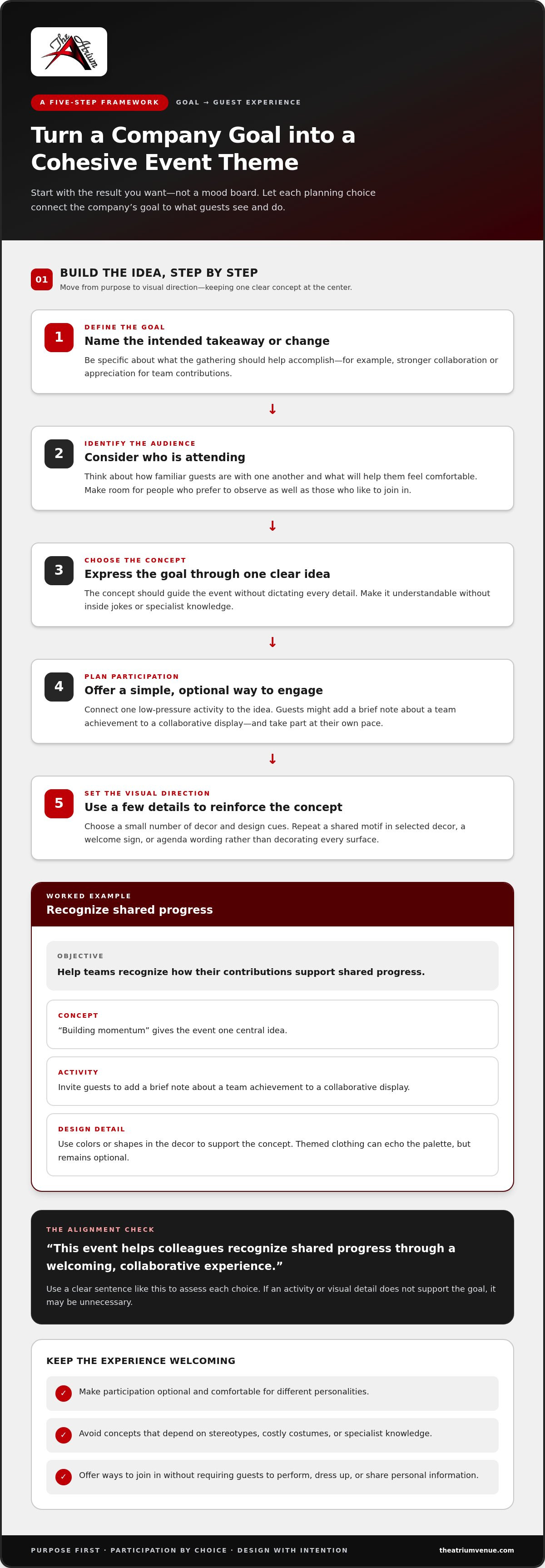
A cohesive theme starts with a result, not a mood board. Use this five-step framework to connect what the company wants to achieve with what guests will experience:
Define the goal. Name the intended takeaway or change, such as stronger collaboration or appreciation for team contributions.
Identify the audience. Consider who’s attending, how familiar they are with one another, and what will help them feel comfortable.
Choose the concept. Express the goal through one clear idea that can guide the event without dictating every detail.
Plan participation. Include an optional activity that gives guests a simple way to engage with the idea.
Set the visual direction. Choose a small number of decor and design cues that reinforce the concept.
For example, if the objective is to help teams recognize how their contributions support shared progress, try a “building momentum” concept. Guests could add a brief note about a team achievement to a collaborative display. The concept is the central idea, the display is an activity, and the colors or shapes used in decor are supporting details. Optional attire might echo the palette, but it shouldn’t be required to understand or enjoy the event.
Choose the message and audience before the aesthetic
Before selecting colors or decor, decide what you want guests to feel, do, or remember. Then consider whether the idea makes sense to people with different roles, backgrounds, and levels of familiarity. A theme should be clear without inside jokes or specialist knowledge, and its participation options should suit both outgoing guests and those who prefer to observe.
Write one sentence to keep decisions aligned: “This event helps colleagues recognize shared progress through a welcoming, collaborative experience.” Use it to assess each choice. If an activity or visual detail doesn’t support that statement, it may be unnecessary.
Build participation and design around one central idea
Keep the experience polished by repeating a few cues rather than decorating every surface. Carry a shared motif through selected decor, a welcome sign, and agenda wording. Offer one low-pressure activity connected to the concept, and make themed clothing optional. Guests can then join in without feeling they must perform a role.
Here’s how an objective can guide practical choices:
These are starting points, not fixed formulas. The strongest unique corporate event themes 2026 translate a company goal into choices guests can recognize and comfortably join. Once the concept is clear, a suitable room and thoughtfully selected event decor options can help express it without letting the setting overshadow the purpose.
Six Unique Corporate Event Themes for 2026, with Activities and Visual Ideas
Use these six concepts as flexible starting points, not fixed packages or predictions about what every company should do in 2026. Choose one that fits the event’s purpose, then adjust the activity and visual direction to your audience, agenda, and brand. Each idea includes the same three planning details to make comparison simple.
Future-Ready Lab, Human Impact Exchange, and Retro-Future Innovation
Future-Ready LabBest fit: A product showcase, strategy gathering, or learning event focused on what comes next.Guest participation: Pair forward-looking demonstrations with a small-group challenge. Invite teams to suggest practical responses to a shared business scenario.Visual direction: Use clean surfaces, simple diagrams, and a few bright accent details. Keep displays easy to explore and leave room for conversation.
Human Impact ExchangeBest fit: Employee recognition, an anniversary, or a gathering celebrating shared accomplishments.Guest participation: Invite attendees to share a short story, appreciation note, or example of meaningful work. Make contributing optional, with space for guests to read and reflect instead.Visual direction: Feature photographs, concise quotes, and warm, consistent signage. Let employee contributions take focus rather than filling the room with decoration.
Retro-Future InnovationBest fit: A creative kickoff or innovation session that benefits from an upbeat, imaginative tone.Guest participation: Offer a playful idea challenge, such as rethinking a familiar workplace task for the future. Keep the prompt accessible, so no specialist knowledge is needed.Visual direction: Combine one or two familiar design references with contemporary shapes and a restrained color palette. Avoid turning the theme into a costume requirement.
Makers and Materials, The Great Idea Exchange, and Purpose in Motion
Makers and MaterialsBest fit: A team workshop or creative gathering where making and sharing ideas are part of the experience.Guest participation: Provide a simple hands-on prompt, such as assembling a small group concept board from supplied materials. Guests can contribute individually or collaborate.Visual direction: Use tactile details, visible work surfaces, and a few carefully arranged materials. Keep the setup tidy and easy to navigate.
The Great Idea ExchangeBest fit: A client reception, cross-team session, or gathering designed to encourage conversation.Guest participation: Set up guided conversation stations with clear prompts, such as “What’s one opportunity we should explore?” Guests can join a discussion or simply listen.Visual direction: Give each station a distinct prompt and consistent signage. Arrange the space to make moving between conversations feel natural.
Purpose in MotionBest fit: A mission-focused gathering, team day, or values-centered celebration.Guest participation: Offer a reflective, optional action, such as writing one way to support a shared goal. Keep the invitation low-pressure and avoid asking for personal disclosures.Visual direction: Use a simple path, linked shapes, or repeated mission language to suggest forward movement without overwhelming the room.
The strongest unique corporate event themes 2026 give guests a clear way into the idea while leaving room for different comfort levels. A thoughtful activity and a few consistent visual cues can make a concept feel cohesive without requiring every attendee to participate in the same way. For organizations seeking expert assistance in bringing these concepts to life, corporate specialists such as AMA Event Management can oversee everything from experiential theme design to end-to-end logistics.
Adapting 2026 Corporate Themes to Audience and Format
A strong theme can take different forms without losing its central idea. The right treatment depends on why people are gathering, how long they’ll be together, and whether attendees already know one another. A lively concept might suit a team celebration but feel distracting during a focused workshop. Adjust the activity and visual emphasis to the occasion rather than expecting every event to use the same level of formality.
Match the experience to the event format
For learning-focused gatherings, keep the agenda clear and structured. Let the theme support the program through session titles, a few visual cues, or a brief opening prompt. Recognition events need room for personal stories and celebratory moments, so avoid packing the schedule with activities that compete with acknowledgments. At client-facing receptions, use polished brand expression and easy conversation starters instead of internal references guests may not understand.
Use this matrix to set the tone before choosing details:
Agenda length matters, too. A short reception may need only a visual welcome and one optional prompt. A longer workshop can introduce the concept gradually through session language and transitions between activities. If guests are unfamiliar with one another, choose activities that work without personal disclosures or forced introductions. For a close-knit team, a more specific shared reference may feel natural, as long as newcomers can still follow along.
Make the concept comfortable for different attendees
Themed events can feel forced when guests are expected to dress up, perform, or display enthusiasm in a prescribed way. Make the theme visible in the environment and give people choices in how they engage. A written response, quiet observation, or casual conversation can all be valid forms of participation. Clear wayfinding and readable signage also help guests understand where to go and what an activity involves.
Optional participation lets a theme welcome different comfort levels without losing its character. That principle helps make unique corporate event themes 2026 feel considerate as well as distinctive. Let the agenda communicate what’s happening, and use consistent decor cues to connect spaces or moments without turning every surface into a themed display.
To see how different room options and decor can support a corporate gathering’s format, explore The Atrium Venue.
Bring a Unique Corporate Event Theme to Life at The Atrium Venue
A well-chosen venue helps a theme feel connected from arrival through the final moments of a gathering. The Atrium Venue offers an 8,300-square-foot event space with the Platinum, Paragon, and Diamond rooms. You can rent an individual room or the full venue, giving you options to shape the setting around your event’s scale, agenda, and guest experience.
Use rooms and decor to create a cohesive guest experience
Think about the event as a sequence of moments. If the format suits it, one room might welcome guests, another could be arranged for the main gathering, and a separate space could support a presentation or conversation. Room selection can help distinguish these moments, while a consistent visual cue, such as a repeated color or motif, makes the overall theme recognizable as guests move between areas.
Professional decor packages can help tailor the setting to your chosen concept. The aim isn’t to decorate every surface. Select details that reinforce the purpose and atmosphere, then leave enough visual breathing room for guests to focus on the event itself. For a collaboration theme, for example, coordinated decor could complement a shared activity without competing with it.
Room choice and decor work best together. Consider how guests will move through the space, where they’ll gather, and which moments deserve the strongest visual emphasis. Renting an individual room can suit a gathering centered in one space; renting the full venue can make it possible to shape a flow across multiple rooms. The right choice depends on your event plan, not on adding more space or decoration than the experience needs.
Move from theme idea to venue planning
Bring a short, practical brief to your venue planning. Include the event’s purpose, approximate guest needs, preferred theme concept, and the atmosphere you want to create. Add a simple agenda outline and note any moments that may benefit from a change of room. These details help clarify how the setting can support the experience.
As you refine the visual direction, consider how transforming an event with decor packages can help carry the concept into the room. If you’re weighing setting and layout choices, use a clear set of priorities for comparing corporate event venues, including how the available spaces could support the event’s flow.
The strongest unique corporate event themes 2026 don’t need elaborate staging to feel considered. A clear purpose, a suitable room plan, and carefully chosen decor can work together to make the occasion cohesive and comfortable for attendees.
Ready to picture your concept in a flexible event space? Explore The Atrium Venue’s event space and decor options and imagine how the Platinum, Paragon, and Diamond rooms could support your gathering.
Give Your Next Corporate Gathering a Clear Direction
A memorable event doesn’t need to impress every guest in the same way. It needs a clear reason for bringing people together and a thoughtful experience that lets them connect with it. As you consider unique corporate event themes 2026, start with one practical question: what would you like attendees to feel, understand, or carry into their work afterward? The answer can guide the choices that follow.
Write down your event’s purpose, the atmosphere you hope to create, and one comfortable way guests could take part. With those decisions in hand, it becomes easier to picture how the setting can support the experience rather than distract from it. A focused starting point also gives your team a shared direction as you shape the details.
When you’re ready to choose a setting, explore The Atrium Venue’s rooms and decor options. Picture your concept in the space and consider how the setting could support the moments you want guests to remember. Your next corporate gathering can feel distinctive, welcoming, and true to your team.
Frequently Asked Questions
What makes a corporate event theme unique?
A corporate event theme is unique when it connects the organization’s purpose with its audience and a memorable way to experience the gathering. An unusual color palette alone won’t create that connection. Even a familiar format, such as a recognition reception, can feel distinctive if guests contribute meaningful messages or stories. When considering unique corporate event themes 2026, try explaining the idea in one sentence, then check that attendees can understand it and take part comfortably.
How do you choose a corporate event theme that fits company culture?
Start with the event’s intended outcome and the values the company genuinely wants to express. Consider what attendees share, such as a recent project or common challenge, as well as their different roles and comfort with group activities. Compare a few concepts against those factors. A theme that sounds exciting but feels disconnected from daily company life may come across as forced. Choose a simple, authentic idea that can guide invitations, activities, and design choices.
Can a corporate event have a theme without a dress code?
Yes, a dress code isn’t needed for a themed event. You can express the idea through table names, welcome messages, agenda wording, or a display that guests encounter as they arrive. For a “shared progress” concept, for example, use table cards with prompts about team milestones. If themed attire could add to the atmosphere, describe it as optional inspiration so guests who skip it still feel included.
How do you make a corporate event theme inclusive?
Choose a concept that doesn’t depend on stereotypes, cultural assumptions, or sharing personal information. Make instructions straightforward, explain unfamiliar references, and provide participation choices that suit different personalities. For example, at a team activity, guests might write a suggestion, discuss it with others, or simply listen. Check signs for readable text and clear directions. The event should feel welcoming even to attendees who prefer a quieter role or need time to understand the activity.
How far in advance should you choose a corporate event theme?
Choose the theme early enough to inform the agenda, guest communications, activities, and visual planning. There’s no universal deadline; lead time depends on the event’s scale and complexity. A useful milestone is to settle the concept once the objective and audience are defined, before drafting invitations or finalizing the program. Share a one-sentence theme statement with everyone shaping the guest experience so decisions remain aligned as details develop.
How can you tell whether a corporate event theme was successful?
Decide what success means before the event, then look for signals related to its purpose. For a learning gathering, you might review participant feedback about the session; for a recognition event, note whether guests chose to share acknowledgments. A brief post-event question can reveal which details felt meaningful or confusing. Keep the assessment proportionate, and don’t credit the theme alone for broader business outcomes. Use what you learn to refine the next gathering.
Comments